OliverCode
A shared foundation for Claude Code that keeps instructions, skills, and safety checks consistent across projects.
The problem
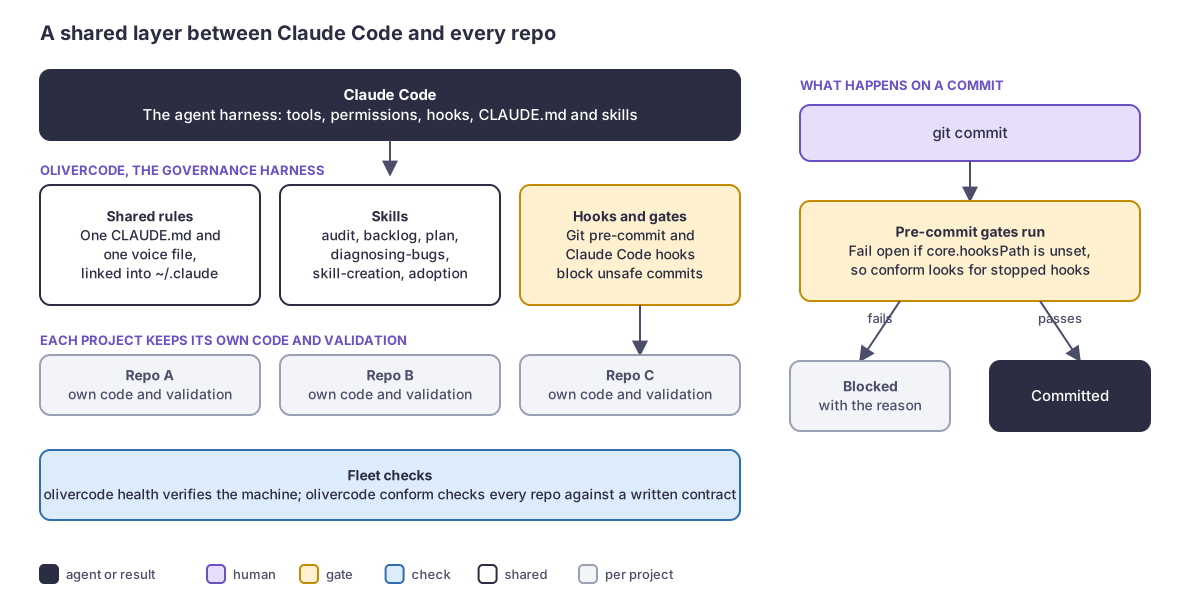
As the number of projects and custom skills grew, keeping everything consistent became its own job. Instructions drifted between repositories, improvements didn't always make it back to other projects, and important safeguards depended too much on remembering to follow them.
I wanted one place to manage how I build, with the same standards and safeguards wherever I work.
The approach
- One shared foundation. Common instructions, voice standards, and skills live in one place and are linked into every project
- Rules that actually run. Git and Claude Code hooks enforce requirements that shouldn't depend on remembering a prompt. Shared standards guide everything else
- Projects keep their independence. Each repository retains its own code and validation commands while inheriting the shared framework
- Checks built into the system. Health checks, repository conformance tests, and installation rehearsals catch problems before they affect active work
The result
OliverCode now runs across the repositories in this portfolio. Improvements to shared skills and standards can be carried across projects without recreating them individually.
Before, instructions and checks varied from one project to the next and depended on memory. Now one install links the shared instructions and skills, a sync step brings each project in line, and a conformance check flags any registered repository whose safeguards have stopped working.
It also provides a growing set of engineering skills for planning, debugging, auditing, managing backlogs, and creating new skills.
The skills
Six skills form the engineering-method layer of OliverCode. Each is a standalone SKILL.md, with supporting references where needed.
Diagnosing bugsdiagnosing-bugsA bug is investigated from a reproducible command that demonstrates the exact failure.
Overview
A fix is not considered complete until the original problem no longer reproduces, the regression test passes or the missing test coverage is documented, and temporary debugging instrumentation is removed.
Where a person stays in control
- Reports the symptom, such as "debug this" or "this is slow"
- Supplies access to the reproducing environment, a captured artifact or permission for temporary production instrumentation when the agent cannot build a loop
- Decides on any architectural change the post-mortem recommends
What runs on its own
- Builds and tightens the loop, and runs it before theorizing
- Stops and lists what it tried when no loop can be built, and refuses to hypothesise without one
- Ranks falsifiable hypotheses, instruments one variable at a time and removes every tagged log at the end
- Writes the regression test before the fix where a correct seam exists
AuditauditThe audit examines a project across seven lenses, including defects, unnecessary complexity, dead code, and test quality.
Overview
Findings must be supported by evidence from the actual files, and recommendations become tracked issues. The goal is a concrete, prioritized list of improvements that someone can act on.
Where a person stays in control
- Names the target, for example "audit this" inside a repo, a skill family, a docs folder, a commit range or a plan file
- Decides the owner questions the audit files as stories that name what they block
What runs on its own
- Reads every line in scope and checks the seven lenses: how a new user gets it working, whether it runs on its own, whether its claims are true, whether each idea has one home, what it carries that nothing uses, what it costs to load and whether its writing follows the voice
- Reruns the evidence behind the biggest claims before reporting them
- Counts size, tests and doc words with scripts and reports the numbers
- Files every finding as a story with a before-and-after command, and fixes nothing during the audit apart from three stated exceptions
BacklogbacklogStories need evidence before they can be closed.
Overview
The skill connects planning, implementation, and backlog maintenance, requiring a logged builder entry before completion. Owner requests that involve meaningful changes are captured before work begins, keeping the backlog useful as a record of what needs doing and what has actually been delivered.
Where a person stays in control
- States the request, and the agent files it
- Says "stop", "do this first" or "drop that" to change the order of work
- Approves any fix the sweep proposes
- Asks for QA when it is wanted
What runs on its own
- Searches before filing and adds duplicates as comments on the existing story
- Writes each story with a user-story sentence, Gherkin acceptance criteria, an epic link and the fields line
- Answers the fit check in the body: what the item extends, whether it is core or an add-on, what it replaces and its effect on size
- Runs the sweep, and reports "Nothing due" when the board is clean or says so plainly when a read was stopped, since a stopped read never counts as clean
- Uses a different agent that built no part of the story for QA, when the owner asks for it
Olivercode adoptionolivercode-adoptionThis skill brings an existing Claude Code setup into the shared framework.
Overview
It first checks the current configuration, separates global, project-specific, and personal instructions, and identifies overlaps. Existing rules are preserved or explicitly flagged, with backups maintained until the owner confirms the migration.
Where a person stays in control
- Agrees to the table that sorts each existing rules file into global, repo-specific or personal
- Confirms which repos are live, which are retired and which should not be governed
- Confirms the validation command proposed for each repo
- Decides when backups can be deleted
What runs on its own
- Reads the documentation so the user does not have to
- Backs up before the first mutation
- Leaves any rule it cannot classify exactly where it is and flags it
- Tells the user two things they rarely know: a rules file named
AGENTS.mdor.cursorrulesnever auto-loads in Claude Code, and a real directory in~/.claude/skills/has no backup anywhere - Reports what moved, what stayed, what is ambiguous, the enforcement probe result and where the backups are
PlanplanPlans are based on what was actually reviewed.
Overview
The skill records how much source material it read and makes any remaining assumptions explicit. Plans are saved as reviewable files so they can be approved and tested before implementation begins.
Where a person stays in control
- Asks for a plan with "make a plan", "write this up as a plan first" or "don't start coding yet, just plan"
- Approves the plan before any execution
- Chooses the repo when the work spans several
What runs on its own
- Reads all N items before writing a sentence that claims something across N named items
- Discloses any partial check in the plan, so the
auditskill's plan route can test the rest - Writes the dated file and stops
- Appends findings during execution and keeps the original plan intact
Skill creationskill-creationNew skills start with an overlap check against the existing collection.
Overview
The skill defines what it will do and who it is for before development begins, then checks that it can operate independently on another machine. Clean-room testing catches missing references, files, or configuration that might otherwise go unnoticed.
Where a person stays in control
- Describes the job in a sentence or two and what a person would say to trigger it
- Shares an example of the input and output wanted, or lists the skills already used for this job
- Approves the four-line target
What runs on its own
- Checks the live fleet for overlap, and does not rely on memory
- Holds the skill to the baseline: no personal facts, no reads outside the skill folder (a skill shipped inside OliverCode may read
$OC/files), a description under 150 words, only three fictional-safe placeholder names (Jane Doe,John Smith,Sally May), and only files the skill uses - Turns any step a command can do into a script, and gives each script a test that goes red without its guard
- Never finishes with a named gap open
How the skills work together
The skills form a continuous development cycle. Adoption establishes the shared framework, planning defines the work, and backlog management turns it into trackable tasks. Bug diagnosis handles failures along the way. Auditing reviews the finished work and sends findings back into the backlog. Skill creation extends the framework as new needs emerge.
Shared principles
- Consistency. Common standards follow the work across repositories
- Verification. Important requirements are enforced by automated checks
- Traceability. Plans, findings, and completed work have a record
- Portability. Skills carry the instructions and references they need
- Recovery. Installation and development processes account for failure as well as the ideal path
What every skill follows
These principles run across the professional and personal collections, with OliverCode enforcing the standards that can be checked automatically.
- Approval before action. Nothing sends, publishes, or deletes without a person's approval
- Review before changing. Skills inspect and propose before applying changes
- Work from real information. Documents and project stories are built from supplied or verified facts, with no invented details
- Explain themselves. Every skill describes its purpose, checks what it needs, and asks before installing anything
- Keep personal information private. Preferences, account data, and personal files stay outside shared skill repositories
- Work together. Skills pass information to the right next step and avoid duplicating work or maintaining competing versions
Stack
Bash, Python 3, Perl, Git hooks, Claude Code hooks.
Evidence
- Six shared skills covering planning, debugging, auditing, backlog management, skill creation, and adoption
- A reusable foundation applied across multiple project repositories
- Automated checks that catch configuration drift and enforce standards across projects
- Installation rehearsals that prove a fresh install in disposable directories
Links
Private repository; available on request.